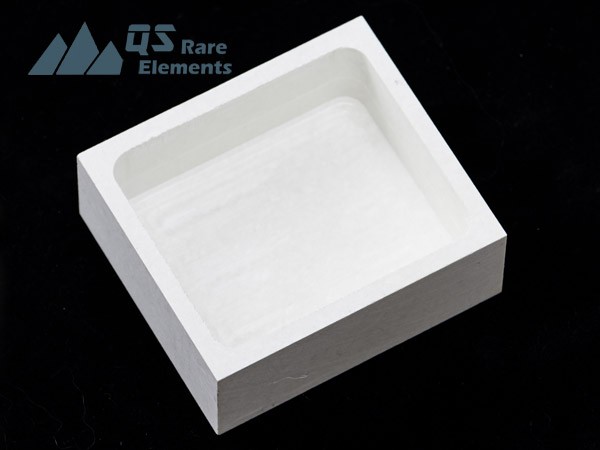
What are Boron Nitride Crucibles and Why Labs Use Them
Boron nitride crucibles are high-performance ceramic vessels purpose-made for melting, containing, or processing materials at very high temperatures while minimising contamination and chemical interaction. They come in a few grades — hot-pressed BN (hpBN), high-purity BN, and pyrolytic boron nitride (PBN) — each tuned for specific thermal, chemical, and vacuum requirements. QS Rare Materials supplies standard and custom BN crucibles used across research, semiconductor, metals, and materials-science facilities.
Boron nitride Crucibles Key material properties
- High temperature stability: BN maintains integrity at temperatures where glass and many oxides fail.- Chemical inertness: BN resists most molten metals, salts, acids and alkalis and is non-wetting for many melts — critical where sample purity matters.
- Low contaminant risk: BN does not introduce carbon contamination like graphite crucibles, so it’s preferred for high-purity crystal growth and semiconductor work.
- Good thermal conductivity + low thermal expansion: These combine to reduce thermal gradients and decrease the risk of cracking under fast temperature changes.
What makes pyrolytic boron nitride (PBN) special?
Pyrolytic Boron Nitride is produced by chemical vapour deposition (CVD) or related processes that deposit BN in thin, dense layers — producing very high purity, low porosity, and exceptional vacuum performance. Compared with standard hot-pressed BN, PBN typically offers:- Higher purity (lower O, C and metallic impurities).
- Superior resistance to oxidation and chemical attack at extreme temperatures.
- Extremely low outgassing and permeability — ideal for ultra-high vacuum (UHV), MBE (molecular beam epitaxy), and crystal growth applications.
Typical applications of Boron nitride Crucibles
- Semiconductor & compound-semiconductor crystal growth (GaAs, InP, etc.) where metal contamination must be minimised.- High-temperature materials processing: melting, alloy development, and lab metallurgy.
- Vacuum and UHV systems: PBN crucibles are used where low outgassing is essential (thin-film deposition, CVD/MBE).
- Analytical chemistry and crucible furnaces where you need chemically inert containers for reactive melts.
Design and customisation options
BN crucibles are machinable (for hpBN) or producible to tight tolerances (for PBN), allowing:
- Cylindrical, rectangular, stepped or tailored shapes, with staged lids or pressure-balancing holes for specific processes.
- Multiple sizes — small lab crucibles up to larger blanks (limits depend on manufacturing method and raw material size).
Boron nitride Crucibles Practical handling, care and selection tips
- Choose grade by application: Use PBN for UHV/MBE and the most contamination-sensitive tasks; hot-pressed BN is cost-effective for many high-temperature, non-UHV uses.- Avoid thermal shock: Pre-heating and controlled ramps reduce risk of cracking even though BN is thermally robust.
- Check wettability: For processes where molten metal contact matters, test small samples — BN is often non-wetting but alloy chemistry can affect behaviour.
- Lid selection: Use staged lids or lids with vents when you need gas exchange but want to prevent spatter or contamination.
Why Labs Choose Boron itride Crucibles over Alternatives
Compared with graphite, quartz, alumina or zirconia crucibles, Boron Nitride frequently wins when you need a combination of:- extremely low contamination risk (no carbon pickup),
- better chemical resistance to aggressive melts, and
- superior performance under vacuum or high temperatures. These advantages explain BN’s adoption in semiconductor and high-purity materials labs.
If you’re specifying a crucible for a process (e.g., MBE, crystal pull, molten salt electrolysis), the important details are: operating temperature, vacuum level, any reactive species present, required geometry, and acceptable contamination limits. For ready-made and custom Boron Nitride Crucibles and machining capabilities, see QS Rare Materials’s BN crucible catalogue and custom crucible options.
Would you like a short technical spec sheet (dimensions, max temp, purity options) for a specific crucible size or process so you can share it with procurement or R&D? I can draft one tailored to your operating temperature, vacuum requirement, and target material.