
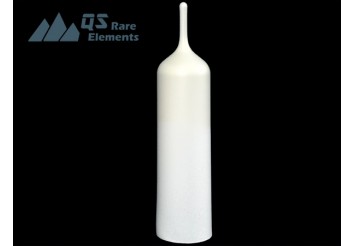
 VGF crucible dimensions should be defined from the crystal-growth process, furnace hot-zone space, charge volume, and handling method rather than selected by diameter alone. When a pyrolytic boron nitride crucible is being considered for a VGF project, the required inner diameter, outer diameter, overall height, wall thickness, bottom profile, and dimensional tolerances should be reviewed together before a custom drawing is finalized.
This guide explains how engineering teams can prepare a technically complete VGF crucible specification, identify the factors that affect manufacturing feasibility, and avoid common drawing omissions that delay technical review. It is intended for crystal-growth laboratories, semiconductor-material developers, vacuum-furnace integrators, and procurement teams sourcing custom ceramic process components.
Why VGF Crucible Dimensions Must Match the Complete Growth System
A VGF crucible is not an independent container selected only by its diameter or volume. Its geometry must work with the crystal material, charge mass, furnace hot zone, heater arrangement, support fixture, insulation layout, loading method, and intended crystal-growth profile.
In a vertical gradient freeze process, the crucible holds the process charge while the furnace creates a controlled axial temperature gradient. The relationship between the crucible body and the furnace environment can influence usable volume, installation clearance, heat-transfer conditions, charge placement, and handling during loading or unloading. For this reason, a technically complete specification should connect the part drawing with actual process information.
Connecting Charge Volume, Crystal Diameter, and Usable Crucible Space
The requested inner diameter is usually related to the desired crystal diameter and the quantity of source material required for the process. However, usable internal volume is influenced by more than the main cylindrical section. Bottom geometry, transition radii, total height, intended melt level, and required free space should all be evaluated before the final internal dimensions are selected.
A drawing that specifies only an inner diameter and a nominal height may not clearly communicate the usable process volume. Buyers should identify whether the requested height refers to total external height, internal depth, effective melt-zone height, or another functional reference point. This reduces uncertainty during engineering review and helps avoid a mismatch between the crucible capacity and the intended charge.
Why Furnace Clearance and Thermal-Zone Location Matter
The outer diameter and overall height should be checked against the furnace hot zone, heating element arrangement, insulation configuration, support system, and available installation clearance. A crucible can have a suitable internal volume but still be unsuitable if the outer geometry does not fit the thermal assembly or leaves insufficient clearance around critical furnace components.
It is also important to identify the intended position of the melt zone relative to the furnace temperature gradient. The overall height of the crucible, the position of the bottom, and the location of the rim can affect where the charge is placed within the thermal field. This is why furnace drawings, available hot-zone dimensions, and support details are useful during a custom review.
How Handling Fixtures Can Affect the Final Crucible Profile
Rim width, lip geometry, grooves, support-contact areas, and edge treatment can affect how a VGF crucible is installed, lifted, aligned, or removed from the process equipment. These features may appear secondary in an early drawing, but they can become critical if the part must engage with a holder, cover, support ring, fixture, or positioning tool.
Before confirming the final profile, buyers should identify all mechanical contact locations. This includes the points where the crucible touches a support system, where a lid rests, where a handling fixture grips the part, and where thermal insulation may be located. Defining these interfaces early helps distinguish critical tolerances from dimensions that can remain less restrictive.
Pyrolytic Boron Nitride Crucible Design Inputs for VGF Projects
A pyrolytic boron nitride crucible used for VGF crystal growth should be evaluated as a combination of material, geometry, process conditions, and installation requirements. CVD-grown PBN is commonly selected for high-purity and vacuum-related process environments, but the final configuration still depends on the required dimensions, wall-thickness distribution, bottom shape, and functional interfaces.
Inner Diameter and Usable Melt Volume
The inner diameter defines the primary space available for the charge and affects the relationship between melt volume and target crystal diameter. The requested ID should be accompanied by information about usable internal depth, expected charge mass, melt height, and any required allowance above the melt level.
When the process has a target crystal diameter, the design review should also consider whether the internal geometry is intended to support a straight cylindrical melt region, a shaped bottom, a transition area, or a specific seed-end arrangement. These details help clarify the functional purpose of the requested dimensions.
Outer Diameter and Hot-Zone Clearance
The outer diameter should be reviewed with the furnace hot-zone dimensions rather than selected independently. Buyers should provide any available information about the heater arrangement, insulation thickness, support components, thermal shields, and permitted clearance around the crucible body.
Where the furnace includes a close-fitting support or a defined heating zone, small dimensional differences can affect installation and positioning. The drawing should identify which outer dimensions are functionally critical and whether the geometry changes along the height of the crucible.
Overall Height, Effective Melt Zone, and Crystal-Growth Length
Overall height can influence loading clearance, charge volume, melt-zone placement, and compatibility with the axial temperature gradient. The requested height should be defined from clear reference points, such as the bottom exterior, internal base, rim top, or support interface.
For complex VGF systems, it can also be helpful to distinguish between total part height and the section of the crucible that will contain the active process charge. This allows the engineering team to compare the effective melt location with the furnace hot zone and the intended crystal-growth direction.
Bottom Geometry, Radii, and Charge Placement
Bottom geometry can affect charge placement, internal volume, support contact, local wall-thickness requirements, and the way the crucible fits within the system. A flat bottom may be appropriate for one equipment arrangement, while a shaped bottom, transition radius, or tapered section may be needed for another process configuration.
Buyers should include the bottom profile in a section drawing whenever possible. The drawing should show flat surfaces, angles, radii, depths, transition points, and any internal or external features that affect how the part rests on a support or receives the charge material.
Rim Features, Grooves, and Fixture-Contact Areas
The rim is often a functional area rather than a decorative edge. It may support a lid, engage with a fixture, provide a handling surface, or define the upper installation position within the furnace. Where a rim includes a lip, groove, flange, recess, or special edge treatment, the drawing should identify its dimensions and the reason for the feature.
Clear information about fixture-contact areas helps prevent unnecessary tight tolerances across the entire part. It also helps ensure that machining attention is focused on dimensions that influence assembly, handling, and process compatibility.
How to Select PBN Crucible Wall Thickness
Wall thickness should be considered together with the required geometry, handling method, furnace space, internal volume, and thermal process. It is not simply a single number applied uniformly to every section of the crucible. The sidewall, rim, bottom, and transition regions can have different functional requirements and should be reviewed as one complete design.
Balancing Handling Strength, Thermal Response, and Machining Feasibility
A thicker section may change the available internal volume and affect the amount of clearance within the furnace. A thinner section may require more attention to handling, edge geometry, packaging, and fixture contact. The appropriate balance depends on the required shape, intended process conditions, and the mechanical demands during loading, unloading, and transport.
Wall-thickness requirements should therefore identify whether a single nominal value is sufficient or whether specific areas require closer control. For example, the main sidewall, bottom, rim, and shaped transitions may need separate notes if their dimensions are functionally important.
How CVD-Grown PBN Affects Wall-Thickness Planning
Pyrolytic boron nitride is produced by chemical vapor deposition, and the manufacturing process should be considered when planning the requested thickness and geometry. CVD material formation, available raw-material dimensions, machining requirements, and the requested part profile can affect the feasibility of a specific design.
For VGF projects, wall-thickness planning should therefore be discussed alongside the requested ID, OD, height, bottom geometry, and rim features. A supplier review can help determine whether the proposed configuration is practical for the selected PBN material form and intended application.
Why the Rim, Wall, and Bottom Should Not Be Treated as Separate Requirements
A crucible drawing may list an overall wall thickness while omitting the rim, base, and transition details. This can create ambiguity because these sections may have different geometry, contact conditions, or functional roles. The rim may engage with a fixture, the bottom may rest on a support, and the wall may define the active melt volume.
Instead of treating each zone as unrelated, the drawing should show how these areas connect. Section views are useful for communicating local radii, wall transitions, grooves, lips, and bottom shapes that may not be visible in an exterior view.
VGF Crucible Geometry Options and Their Design Considerations
Different VGF projects may require different crucible profiles. Geometry should be selected according to the equipment configuration, charge material, target crystal shape, furnace layout, and process-development requirements. The following examples are design categories rather than universal standard configurations.
| Geometry Type | Typical Design Purpose | Key Engineering Checks | Information Needed for Review |
|---|---|---|---|
| Straight-wall design | Supports a consistent internal diameter over the main body of the crucible. | Hot-zone clearance, charge volume, rim support, and wall-thickness consistency. | ID, OD, height, wall thickness, and support arrangement. |
| Tapered-wall design | May be considered where loading, extraction, thermal distribution, or furnace geometry requires a changing diameter. | Taper angle, transition location, usable volume, and machining feasibility. | Top and bottom diameters, taper length, drawing, and process purpose. |
| Flat-bottom design | Provides a simple base geometry where the furnace setup and charge arrangement permit it. | Bottom support area, local stress, charge placement, and thermal-contact conditions. | Bottom thickness, support detail, and contact-area information. |
| Shaped-bottom design | May be used where the process requires a defined bottom transition, seed-end feature, or charge-positioning geometry. | Radius, depth, local wall thickness, fixture clearance, and thermal considerations. | Section drawing, critical radii, target tolerance, and application notes. |
Straight-Wall Crucibles
A straight-wall design uses a substantially consistent diameter through the main body of the crucible. This type of geometry can simplify the definition of usable internal volume, but it still requires review of the wall thickness, bottom transition, rim configuration, and outer clearance within the furnace system.
For a straight-wall drawing, buyers should clearly define the internal and external diameters, total height, internal depth, bottom thickness, rim detail, and any support-contact requirements. A simple body shape does not remove the need to verify installation conditions and thermal-zone positioning.
Tapered-Wall Crucibles
A tapered-wall profile may be considered when the process, furnace geometry, loading method, or intended charge configuration requires a change in diameter along the crucible height. The taper should be shown in a section drawing with clear dimensions for the top diameter, bottom diameter, taper length, and transition points.
Because a taper changes both internal volume and outer clearance, it should be reviewed against the furnace hot zone and the expected charge position. The design should also identify whether the taper is functional for loading, extraction, thermal considerations, or equipment fit.
Flat-Bottom and Shaped-Bottom Configurations
A flat-bottom design may be used where the support arrangement and charge placement allow a simple base profile. A shaped bottom can be considered where the process requires a defined internal transition, seed-end feature, or geometry that matches a specific support or thermal configuration.
Bottom geometry should not be described only in text. A sectional view is preferred because it can show the full relationship between the internal shape, external support area, local radii, bottom thickness, and transition into the sidewall.
Seed-End Features and Application-Specific Geometry
Some VGF systems may require application-specific features near the bottom or at the rim. These may include defined radii, recesses, grooves, transitions, or support interfaces. The design purpose of each feature should be identified so that the review focuses on the correct dimensions and potential manufacturing limitations.
If the feature is based on an existing sample or a legacy drawing, buyers should also explain which dimensions must be duplicated and which can be modified. This distinction helps prevent the unnecessary replication of non-functional details while preserving interfaces that matter to the furnace setup.
Key VGF Crucible Dimensions to Define Before Design Review
The following table helps project teams organize the information required before a custom design review. It is intended as a specification checklist rather than a list of standard sizes.
| Parameter | Why It Matters | Information to Provide | Common Omission |
|---|---|---|---|
| Inner diameter | Defines usable charge space and influences the target crystal diameter. | Target ID, allowable tolerance, and required usable volume. | Providing charge mass without the target internal geometry. |
| Outer diameter | Determines compatibility with the furnace hot zone, heater arrangement, and support system. | Target OD, available furnace clearance, and fixture-contact locations. | Ignoring insulation, heater, or support clearance. |
| Overall height | Influences charge loading, growth-zone alignment, and installation clearance. | Total height, effective melt-zone height, and permitted tolerance. | Not identifying the height that is functionally critical. |
| Wall thickness | Affects handling, thermal behavior, machining feasibility, and available internal volume. | Nominal thickness, critical locations, and acceptable variation. | Using one value without defining rim and bottom requirements. |
| Bottom geometry | Can affect charge placement, melt distribution, thermal conditions, and support contact. | Flat, tapered, rounded, or shaped bottom with radii and depth. | Leaving transitions and radii undefined. |
| Rim and fixture features | Influence handling, lifting, covers, supports, and mechanical contact during loading. | Rim width, lip profile, grooves, and fixture-interface details. | Providing the vessel body without attachment or support information. |
Dimensions and Tolerances to Include on a VGF Crucible Drawing
A useful VGF crucible drawing should distinguish between critical functional dimensions and dimensions that are primarily descriptive. This helps the supplier understand which interfaces require closer control and allows the project team to avoid applying unnecessarily tight tolerances to every part feature.
Critical Dimensions Versus Non-Critical Dimensions
Critical dimensions are usually the dimensions that interact with the furnace, holder, support fixture, lid, insulation system, heating zone, or another assembled component. Examples may include the outer diameter at a support point, the rim width used by a fixture, the bottom profile that rests on a holder, or the internal diameter required for a defined charge volume.
Non-critical dimensions may still be important for general fit and handling, but they may not require the same tolerance level. Marking functional interfaces on the drawing helps the supplier understand the purpose of each critical dimension and can make the technical review more efficient.
Defining Tolerances Based on Furnace Interfaces
Tolerances should be linked to actual assembly requirements. A close-fit furnace interface may need a more specific tolerance than an exterior surface with no direct contact. Buyers should identify the functional reason for each tight tolerance, especially where it affects the rim, outer diameter, bottom support area, or a machined groove.
When a drawing is based on an existing part, it is useful to indicate whether the existing tolerance is mandatory or whether it was simply inherited from a previous drawing. This can help prevent unnecessary restrictions during a new project review.
How to Communicate Surface, Edge, and Inspection Requirements
In addition to dimensions, the drawing should identify any required surface condition, edge treatment, inspection points, marking requirements, packing instructions, or documentation needs. These details are especially useful when the component will be used in a sensitive vacuum or crystal-growth environment.
If a specific inspection method or material document is required, the buyer should state this before quotation. This allows the technical review to consider whether the requested documentation, dimensional inspection, and handling requirements are appropriate for the project.
Information Needed Before Requesting a Custom VGF Crucible Review
A complete request helps shorten the clarification cycle and supports a more accurate feasibility assessment. The information below does not need to be presented in a complex format, but it should be available before the design is finalized.
- Target inner diameter, outer diameter, total height, and internal depth
- Nominal wall thickness and any critical thickness areas
- Bottom shape, radii, taper, rim features, grooves, or other machined details
- Dimensioned drawing, section view, existing sample, or reference sketch when available
- Crystal material, process charge, target crystal dimensions, and expected charge volume
- Operating temperature, process duration, vacuum level, or gas atmosphere
- Furnace hot-zone dimensions, heating arrangement, support method, and clearance limitations
- Required quantity, documentation needs, inspection requirements, and packaging considerations
Crystal Material, Charge Mass, and Target Growth Conditions
The crystal or charge material is important because it helps define the process context for the requested crucible. Buyers should provide the material identity, estimated charge mass or volume, target crystal dimensions, process duration, and any purity or contamination-control requirements relevant to the project.
This information should be considered together with the requested geometry. It helps the engineering team understand why the selected ID, height, bottom profile, and wall thickness are required for the intended VGF process.
Furnace Configuration, Heating Arrangement, and Available Space
Furnace drawings, photographs, dimensioned sketches, or written clearance information can help identify potential issues before a custom part is machined. The most useful information includes the available hot-zone diameter, maximum height, heater location, support system, insulation layout, and any areas where the crucible must fit closely with another component.
Where detailed equipment drawings are unavailable, buyers can still provide the known ID, OD, height limitations, support-contact dimensions, and photographs of the current setup. Even partial information can help guide the initial review.
Operating Temperature, Vacuum Level, and Process Atmosphere
Operating conditions should be included because the crucible design is part of a thermal process. Buyers should identify the maximum temperature, estimated heating and cooling profile, process duration, vacuum level, gas atmosphere, and whether the part will be exposed to repeated thermal cycles.
These conditions help provide context for the requested material, geometry, handling method, and documentation requirements. They also support discussions about application-specific compatibility and process evaluation.
Quantity, Drawing Status, Documentation, and Sample Requirements
Quantity affects how the project should be planned, especially when the buyer requires an initial evaluation part, a small development batch, or a repeat production quantity. Buyers should also state whether a final drawing is available, whether a sample is needed for review, and whether material documentation or dimensional inspection records are required.
For projects requiring a custom component, review the Pyrolytic Boron Nitride VGF Crucible specifications from QSAM for material information, CVD production details, available documentation, and custom-machining discussion.
From VGF Process Requirements to a Crucible Drawing
The following review path helps prevent incomplete specifications and reduces repeated clarification during a custom design discussion.
Crystal Material and Required Charge Volume
                ↓
Target Crystal Diameter and Growth Length
                ↓
Furnace Hot-Zone Space and Heater Arrangement
                ↓
Crucible Inner Diameter, Outer Diameter, and Height
                ↓
Wall Thickness, Bottom Geometry, and Rim Features
                ↓
Drawing, Tolerances, Material Documentation, and Quantity
                ↓
Custom PBN VGF Crucible Feasibility Review
Each stage provides information needed for the next stage. For example, a target crystal diameter may suggest an initial internal diameter, but the final outer diameter cannot be confirmed until the required wall thickness, furnace space, and support arrangement have also been reviewed.
Typical Design Review Example for a VGF Crystal-Growth Project
A crystal-growth development team needed to define a crucible for a VGF system already in use. The project required a geometry that could accommodate the planned charge volume while fitting within the available furnace hot zone and existing support arrangement.
Buyer Requirement
The buyer provided a preliminary drawing with target inner diameter, outer diameter, overall height, and a basic bottom profile. The team also shared the intended crystal material, estimated charge volume, furnace-space limitation, operating conditions, and the areas where dimensional tolerance was critical for assembly.
Engineering Review Approach
The design review focused on the relationship between the requested internal volume, furnace clearance, wall-thickness requirement, bottom transition, and rim contact area. The requested dimensions were evaluated against the practical limitations of CVD-grown PBN material and the machining requirements for the proposed geometry.
Specification Outcome
The project team received a more complete specification package that identified the critical dimensions, tolerance priorities, bottom-profile details, and information needed for a custom Pyrolytic Boron Nitride Crucible review. This allowed the buyer to proceed with a clearer technical basis before confirming the final configuration.
Common VGF Crucible Specification Mistakes
Many project delays occur because a drawing communicates the general shape but not the functional requirements. The following issues are common during early-stage VGF crucible discussions.
Providing Only Diameter and Overall Height
An ID, OD, and height are useful starting points, but they do not define bottom geometry, usable internal volume, rim features, support-contact areas, wall-thickness distribution, or furnace-clearance requirements. A section drawing is often needed to complete the design information.
Omitting Bottom Geometry and Transition Radii
A bottom that appears simple in an exterior drawing may include critical internal or external features. When radii, taper, bottom thickness, or transition points are not shown, the supplier may need to request clarification before evaluating the part.
Using a Single Wall-Thickness Value Without Identifying Critical Areas
Wall thickness should be reviewed across the rim, sidewall, bottom, and transition areas. A single value may be insufficient when the part includes shaped sections, grooves, a defined rim, or a bottom feature that must work with a support fixture.
Not Providing Furnace Clearance or Fixture Information
Without information about the heater arrangement, hot-zone space, insulation, supports, and handling fixtures, it is difficult to confirm whether the requested outer geometry will fit the intended system. Even a simple clearance sketch can be valuable during technical review.
Requesting Inspection Tolerances Without Stating the Functional Interface
Very tight tolerances may be necessary in some locations, but they should be connected to an actual function such as a support interface, lid fit, holder engagement, or alignment requirement. Identifying the functional reason helps focus the drawing on the dimensions that matter most.
FAQ About VGF Crucible Dimensions and PBN Design
What dimensions are required to quote a VGF crucible?
A technical quotation normally requires the inner diameter, outer diameter, overall height, wall thickness, bottom geometry, rim or fixture features, dimensional tolerances, quantity, and a drawing when available. The crystal material, charge volume, operating temperature, vacuum or atmosphere, and furnace-space limitations also help support an accurate review.
Why does wall thickness matter for a pyrolytic boron nitride crucible?
Wall thickness affects internal volume, furnace clearance, handling considerations, thermal response, and machining feasibility. For CVD-grown PBN components, wall thickness must also be evaluated in relation to the available material form and the requested geometry. The rim, sidewall, bottom, and transition areas should be reviewed as part of one complete design.
Can a VGF crucible be made from an existing sample or drawing?
An existing drawing or sample can be useful for technical reference. However, a review should still confirm the functional dimensions, tolerances, material requirements, furnace interfaces, bottom geometry, and any features that may affect machining feasibility or installation.
What process data helps evaluate a custom PBN crucible geometry?
Helpful information includes the crystal or charge material, target charge volume, furnace hot-zone dimensions, operating temperature, vacuum or gas environment, expected process duration, heating arrangement, support method, and required quantity. A section drawing is particularly useful when the part includes a shaped bottom, rim feature, or special transition.
Should the lowest tolerance be applied to every VGF crucible dimension?
Not necessarily. Tolerances should be assigned according to functional need. Dimensions that interface with a furnace fixture, support, lid, or heater-zone boundary may require closer control, while non-critical dimensions may allow a more practical tolerance. Identifying critical interfaces in the drawing helps make the review more efficient.
Related Technical Resources
- Understand the VGF process and the role of PBN crucibles
- Review an InP crystal-growth discussion using the VGF method
- Explore custom-machined PBN components
Prepare a Complete VGF Crucible Specification
Complete technical information helps align the VGF crucible with the furnace setup, charge material, and target crystal-growth process. Before submitting a project for review, prepare the required ID, OD, height, wall thickness, bottom profile, tolerance requirements, process conditions, drawing, and quantity.
For projects that require a custom PBN component, QSAM can review the proposed configuration through its PBN VGF crucible product page, where buyers can submit their application details and dimensional requirements for evaluation.